
Asking three roles—analyst, reviewer, and editor—to produce one headline from a short note can make the process larger than the result. But asking one long prompt to select, summarize, source-check, and assemble a briefing from many articles makes it hard to find where a fact changed. Split the workflow according to the failures you need to detect.
When is one prompt enough?
Start with a single request when the input is small, the goal is singular, and you can inspect the output directly. A headline for this note needs little intermediate state:
Input: The new version will roll out gradually starting Tuesday. Its completion date is undecided.
Request: Suggest one English headline without adding facts.
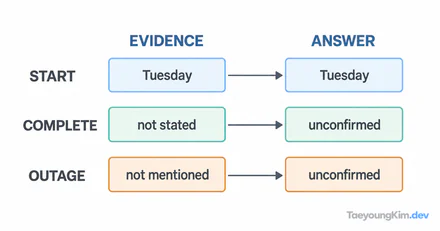
“New version to roll out gradually starting Tuesday” stays within the note. “Rollout complete” does not. You can catch that mismatch by comparing the one input and output without building a longer chain. A single request also has fewer calls and review points.
When should you split the prompts?
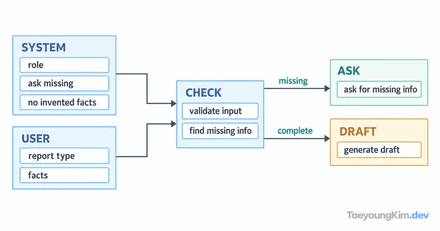
The diagram contrasts a directly checkable headline with a multi-article briefing. Splitting selection, summarization, and editing lets you identify which step introduced an error.
Now imagine selecting important items from several articles, summarizing each one, and combining them into a briefing. Different things can go wrong: selection may omit an important article, a summary may introduce an unsupported fact, or final editing may drop a source link.
| Step | Input | Result to retain | Check |
|---|---|---|---|
| Selection | Article list | Selected articles and reasons | Are they within the specified scope? |
| Summary | Selected source articles | Key claims and source locations | Is any claim absent from the source? |
| Editing | Checked summaries | Briefing | Are headline, summary, and source present? |
The value is not the number of steps. It is knowing where to go back when something fails.
How do you test intermediate results?
Add a short article that omits a tempting fact. At selection, check that the model does not invent an article or title. At summary, check that it does not infer the omitted fact. At editing, check that it retains the source. A plausible final briefing alone cannot show where the distortion began.
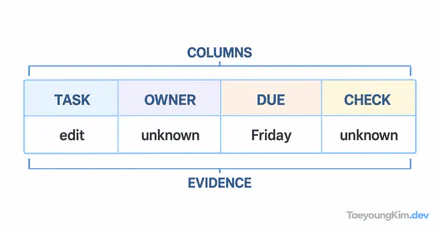
Pass only necessary fields between steps, keeping an identifier that links each result to the original article. Rewriting summaries repeatedly may smooth the prose while giving it more chances to drift from the source. Decide which failed step can be rerun and where a person should review the result.
What changes in operating cost and security?
More stages mean more calls, latency, and intermediate data to store. Repeating sensitive source text in every step or retaining it in logs also widens exposure. Begin with one request for a simple task and add stages when you need separate checks. Model output from an intermediate stage is still not evidence of what the original source says.
Key takeaways
A single prompt is concise when one result can be reviewed directly. When selection, summary, and editing can fail in different ways, keep an output and a check for each stage. Weigh those checks against extra cost, delay, and data exposure.