
You need to create a server and install a web server inside it. If a tutorial uses both Terraform and Ansible, should you choose only one? The tools can overlap, but this example becomes clearer when you separate creating and tracking cloud resources from configuring software on the created server.
Which state does Terraform manage?
The diagram assigns VM and network-resource lifecycle to Terraform and package, file, and service configuration inside the VM to Ansible. These are responsibilities chosen for this example, not absolute capability limits for either tool.
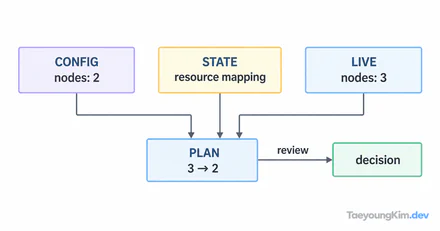
Terraform declares desired infrastructure in configuration files and uses state data to track the real resources it manages. In a hypothetical setup, it creates a VM, network, and firewall rules and previews their changes:
Terraform configuration: 1 VM + network rules
Current cloud state: 0 VMs
Question for the plan: Which resources will be created or changed?
terraform plan proposes changes; apply performs them. Read the plan before applying it, because a change can replace or delete a resource unexpectedly. State can contain infrastructure information, so control its access and storage. The tutorial sequence init → plan → apply is a starting point for understanding this workflow. HashiCorp's plan documentation confirms that planning itself does not change resources.
What does Ansible do on the created server?
Ansible uses an inventory to select managed hosts and Playbook tasks to automate steps such as package installation and configuration. After Terraform creates the VM, an Ansible Playbook could install a web server package and place its configuration file there.
Managed host: the newly created VM
Playbook goal: install a web server package and place its config file
Question for a rerun: Does it change a setting that is already correct?
Many Ansible modules are designed to leave a correct state unchanged, but not every Playbook is automatically idempotent. Test repeated runs when you use arbitrary shell commands or external API calls. The Ansible Playbook guide describes Playbooks as an automation and configuration mechanism.
What failures should you check after splitting responsibility?
If Terraform creates the VM but Ansible cannot connect, check its address, network rules, and login account. If the package is installed but the app fails, inspect configuration, service state, and logs. Treating both steps as one failure makes it harder to decide whether Terraform must be reapplied or only the Playbook needs a fix.
If someone changes a cloud resource outside Terraform, its managed state and real infrastructure can diverge. Read a new plan and decide whether to preserve the manual change or return to configuration. Manual changes on the server can likewise be overwritten by an Ansible rerun. Decide which tool owns each setting and how outputs, execution order, and retries pass between steps.
What if you use only one tool?
One tool may handle everything in a small exercise. This split is a design example, not a universal rule. Team experience, resources, approval requirements, and audit needs can lead to another boundary. The important choice is ownership: avoid two tools competing to overwrite the same resource or setting.
Key takeaways: assign provisioning and configuration separately
Terraform often fits cloud-resource configuration and state tracking, while Ansible often fits applying software and settings inside servers. Inspect the infrastructure plan and the result of repeated configuration runs, and give each resource one clear owner.