
first and last describe order; top and bottom describe vertical position; before and after place something relative to another point. In code and documentation, a familiar direction word can change meaning when the reference point changes. Check the axis and boundary before interpreting it.
Core words
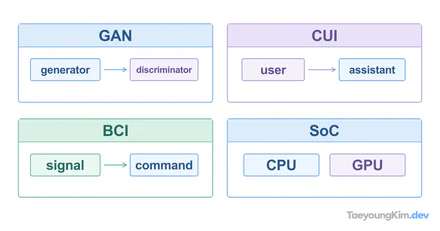
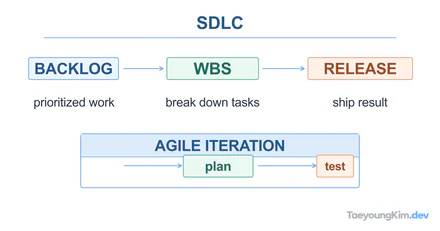
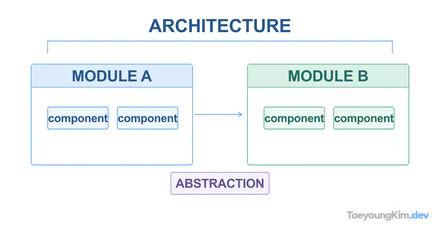
The illustration contrasts order, vertical position, and relative sequence. Each pair answers a different question about where an item sits.
| English term | Meaning and use |
|---|---|
first / last | The earliest and latest items in an ordered sequence. |
top / last | May describe a leading item and a final item on different axes; these are not a standard opposite pair. Use top / bottom for vertical position or first / last for sequence order. |
head / tail | The beginning and end of a data structure, stream, or document section; the exact location depends on the structure. |
header / footer | Content at the beginning and end of a page, message, or document region. |
top / bottom | The highest and lowest positions in a vertical layout or stack. |
up / down | Movement or orientation toward a higher or lower point. |
upper case / lower case | Capital and small letter forms; uppercase and lowercase are also common spellings. |
under / over | Below and above a stated value or position. In strict numeric comparisons, “under 10” means < 10 and “over 10” means > 10; check context for nonnumeric uses. |
or under / and over | Inclusive limits: “10 or under” means <= 10; “10 and over” means >= 10. |
greater than | A strict comparison above a value, written >. |
Words to distinguish together
| English term | Meaning and use |
|---|---|
not less than | At least the stated value, written >= or ≥. |
less than | Strictly below the stated value, written <. |
previous / next | The item before and the item after the current one in a sequence. |
forward / backward | Movement in the sequence's defined direction or against it. |
foreground / background | A front or back visual layer; in process control, foreground and background can also describe how a job interacts with the terminal. |
before / after | Earlier and later relative to a specified event or item. |
parent / child / children / self | A containing or originating node, one subordinate node, several subordinate nodes, and the current object or node. |
parameter / argument | A parameter is named in a function definition; an argument is the value supplied at a call site. |
property / attribute | Both describe a characteristic, but usage depends on the system: an object can expose a property, while an HTML element can have an attribute. |
number / numeric | number names a number or identifier; numeric is an adjective for data represented or handled as numbers. It does not mean decimal-only. |
Words encountered in code
| English term | Meaning and use |
|---|---|
sum / total | A sum is the result of addition; a total is the complete amount, which may be a sum in a particular context. |
limits / bounds / range | limits are restrictions, bounds are the edges or constraints on allowable values, and a range is the interval or span of values. |
top / peak / spike | top is the uppermost position; peak is a maximum level; spike is a sudden sharp rise, often visible on a chart. |
letter / character | A letter is an alphabetic symbol; a character can also be a digit, punctuation mark, or other text symbol. |
title / caption | A title names a document, page, or work; a caption briefly describes a figure, table, or video. |
issue / problem | An issue can be a topic, concern, or tracked work item; a problem is something that needs a solution. The words can overlap. |
just / only | Both can mean “merely,” but just also has timing and precision senses, while only often emphasizes exclusivity. Choose by context. |
within | Inside a stated time, distance, or boundary. “Within 3 seconds” sets a three-second limit. |
A passage from technical documentation
topandheadmay both seem to mean “at the front,” but a layout, a data structure, and a numeric comparison can use different reference points.
When a sentence contains several unfamiliar terms, find its subject and action first. Then identify which words set the range, state, or tool. That makes it easier to interpret each term by role instead of memorizing an isolated translation.
Key takeaways
Check the reference point and whether the boundary is included. first / last expresses sequence order; foreground / background depends on a visual or process context; within defines an inside limit. The same directional intuition does not automatically transfer from one context to another.