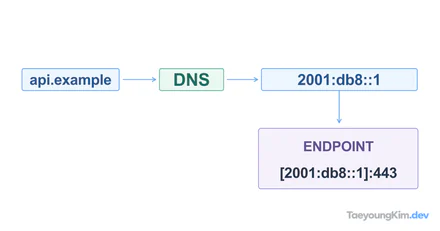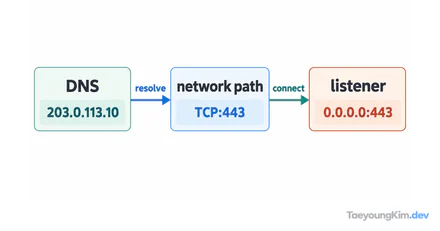

Resolving a name and delivering data are different steps. DNS can return an IP address for a name; on a local IPv4 link, ARP can resolve an IP address to a link-layer address. TCP or UDP then distinguishes application endpoints with ports. Knowing which layer answers which question helps you investigate the right failure.
Core words
The diagram places name lookup, local IPv4 address resolution, and transport endpoint selection in separate roles. It does not imply that every packet triggers a fresh DNS or ARP lookup.
| English term | Meaning and use |
|---|---|
OSI 7 Layers | A seven-layer reference model for describing network functions, from physical signaling through applications. It is a conceptual model, not a claim that every protocol maps perfectly to one layer. |
PDU | Protocol Data Unit: the data and control information handled by a protocol at a particular layer; a frame and a packet are examples at different layers. |
SDU | Service Data Unit: data handed from a higher layer to a lower layer's service, distinguished from that lower layer's complete PDU. |
SAP | Service Access Point: the conceptual point where one layer accesses services of an adjacent layer. |
NIC | Network Interface Card or controller: hardware that connects a host to a network medium. |
Protocol | Agreed rules for formatting and exchanging information between communicating systems. |
Words to distinguish together
| English term | Meaning and use |
|---|---|
TCP | Transmission Control Protocol: a connection-oriented transport that provides an ordered byte stream and reliability mechanisms. |
UDP | User Datagram Protocol: a connectionless datagram transport without TCP's built-in ordered delivery or retransmission guarantees. |
SNMP | Simple Network Management Protocol: a standard way to query and manage information exposed by network devices. |
IP | Internet Protocol: provides addressing and packet delivery across networks; it does not by itself guarantee delivery. |
FTP | File Transfer Protocol: an application protocol for transferring files, distinct from the lower-layer transport that carries it. |
SMTP | Simple Mail Transfer Protocol: an application protocol used to transfer email between mail systems. |
Words encountered in network work
| English term | Meaning and use |
|---|---|
ARP | Address Resolution Protocol: resolves an IPv4 address to a link-layer address on the local network. IPv6 uses Neighbor Discovery instead. |
MAC Address | A link-layer address associated with a network interface; assignment and uniqueness are not guaranteed to be permanent across all environments. |
MUX | Multiplexing: combining multiple logical streams or users over a shared communication resource. |
Sliding window | A flow-control technique allowing multiple units to be in flight before acknowledgments, within a negotiated or calculated window. |
OGSA | Open Grid Services Architecture: a historical standards effort connecting grid-computing resources with web-service concepts. |
A passage from network documentation
IP addresses packets, TCP and UDP define transport behavior and ports, and ARP resolves an IPv4 neighbor's link-layer address on the local link.
If a hostname does not resolve, inspect DNS. If a local IPv4 neighbor cannot be reached, inspect link and address resolution. If the destination IP is reachable but an application connection fails, inspect the transport protocol, port, and service. These checks are related but not interchangeable.
Key takeaways
Read network terms by layer and job. PDU and SDU describe data units at a boundary; TCP and UDP describe different transport behavior; ARP serves local IPv4 address resolution. SNMP and the historical OGSA belong to very different application and architecture contexts despite appearing in one vocabulary list.