
A relationship describes how entities connect; cardinality says how many instances may connect. Keys identify rows, while constraints limit valid data. Read these words as parts of a model rather than interchangeable names for a table.
Core words
The diagram groups relationships, keys, and schema concepts by the role each plays in structuring data.
| English term | Meaning and use |
|---|---|
cardinality | The number of instances of one entity that may be associated with an instance of another; often expressed as one-to-one or one-to-many. |
Relationship | An association between entities or their instances in a data model. |
constraint | A rule limiting allowable values or relationships, such as uniqueness or a foreign-key rule. |
DFD | Data Flow Diagram: a visual model of how data moves between processes, stores, and external actors. |
Identifier | An attribute or attribute set used to distinguish one entity instance from another. |
NULL value | A marker for missing or unknown data in SQL; it is not zero or an empty string. |
Primary key | The chosen column or column set intended to uniquely identify each row. SQL normally requires non-NULL key values, but SQLite has legacy exceptions for some primary-key declarations. |
Foreign key | A column or column set whose values refer to a key in another table, subject to the defined referential rule. |
Words to distinguish together
| English term | Meaning and use |
|---|---|
Candidate key | A minimal attribute set capable of uniquely identifying a row; one candidate key may be selected as primary. |
Relation | A table-like set of tuples defined by attributes in the relational model. |
Tuple | A row of values in a relation. |
Integrity | The correctness and consistency of stored data according to the model's rules. |
System catalog | Database metadata maintained by the DBMS about objects such as tables, columns, and indexes. |
Optimizer | The DBMS component that chooses an execution plan for a query from possible alternatives. |
Schema | The defined structure and rules for database objects and their relationships. |
View | A named query presented as a table-like object; some DBMSs also support materialized views, which store results. |
Words encountered in code and operations
| English term | Meaning and use |
|---|---|
Inline view | A subquery used in the FROM clause and treated as a table expression for that query. |
Cluster | A physical organization that places related data near each other to improve certain access patterns; meaning varies by DBMS. |
Transparency | In a distributed database, hiding details such as data location, replication, or fragmentation from users. |
Fragment | A partition of data stored or managed separately in a distributed design. |
Allocation | The choice of which site or server stores each fragment and whether it is replicated. |
Broad data | A context-dependent business term for varied data sources beyond a narrow data set; check the author's definition before treating it as a formal DB concept. |
Smart data | Data selected and processed for a specific useful decision, emphasizing relevance and quality over raw volume. |
Reading these terms in context
A primary key identifies a row in its own relation; a foreign key refers to a key in another relation. A candidate key can identify a row but is not necessarily the one selected as primary. Those distinctions matter when reviewing an ER model or a migration.
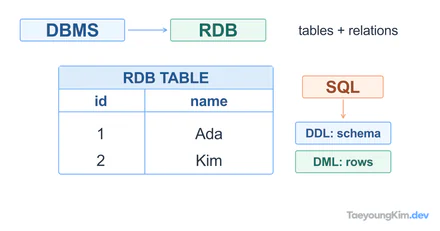
The relation stores tuples under a schema; its constraints and keys describe which rows are valid and how they connect.
Key takeaways
First identify the entity and relationship, then cardinality and keys, then constraints and schema. A view presents a query result, while an inline view is a subquery in FROM. Distributed fragments and allocation concern where data is placed, not what a primary key means.