
Calling a DBMS and a database the same thing blurs the software that manages data with the data it stores. In a relational database, DDL changes structure while DML queries or changes rows. Before reading a SQL command, identify whether it affects schema, data, permissions, or a transaction.
Core words
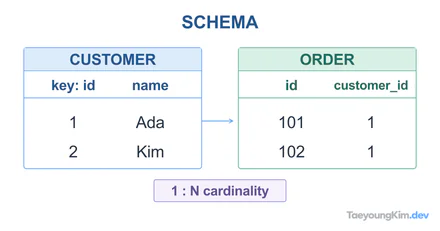
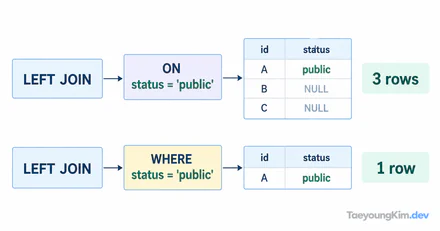
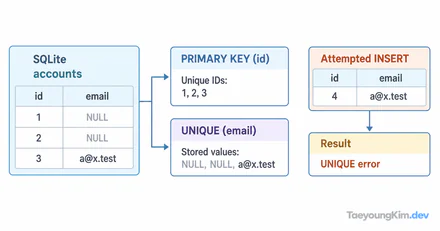
The diagram separates the management system from the relational data model, then shows how SQL commands can work on structure and rows.
| English term | Meaning and use |
|---|---|
DBMS(Database Management System) | Software that defines, stores, queries, updates, secures, and recovers databases, often coordinating concurrent users. |
JDBC(Java Database Connectivity) | Java's database-access API. A JDBC driver connects Java code to a particular DBMS. |
ODBC(Open Database Connectivity) | A database-access interface and driver model used by applications to work with different DBMSs; it is not itself a query language. |
Database(DB) | An organized collection of related data for an application or organization, managed by a DBMS. |
Backup | A copy of data kept so it can be restored after loss or corruption. A backup needs a tested restore procedure. |
RDB | A relational database that represents data in relations, commonly tables, with rows, columns, keys, and constraints; distinct from a simple key-value store. |
Words to distinguish together
| English term | Meaning and use |
|---|---|
Structured Query Language(SQL) | The standard language family for defining, querying, changing, and controlling relational data. Command labels such as DDL and DML group different purposes. |
DDL | Data Definition Language: commands such as CREATE, ALTER, and DROP that define or change database structures. |
DML | Data Manipulation Language: commands that retrieve or change data, such as SELECT, INSERT, UPDATE, and DELETE. Some classifications place SELECT in a separate “DQL” group. |
DCL | Data Control Language: commands concerning access privileges, commonly GRANT and REVOKE. |
TCL | Transaction Control Language: a teaching label for transaction commands such as COMMIT and ROLLBACK; it is not a separate SQL language or necessarily a formal subset of DCL. |
Transaction | A logical unit of database work that is committed together or rolled back as a unit, subject to the DBMS's transaction rules. |
Words encountered in code
| English term | Meaning and use |
|---|---|
SQL Mapping | An application approach where code or mapper definitions explicitly associate SQL statements and result columns with program values. JDBC and ODBC are access APIs, not SQL-mapping techniques themselves; MyBatis is a mapper example. |
ORM | Object-Relational Mapping: mapping program objects to relational data, as in Hibernate or JPA-based applications. It still relies on SQL and a DBMS underneath. |
Debugging | Finding and correcting a program's errors by examining its behavior, state, and code. |
Syntax error | An error caused by code or a command that violates the language's grammar. |
Comment | Text in source code intended for readers and generally ignored as an instruction by the language parser or compiler. |
The distinctions above follow the roles shown in PostgreSQL's SQL command reference and Microsoft's ODBC overview. The DDL/DML/DCL/TCL labels are useful categories, but individual systems document commands and transaction behavior in their own terms.
A passage from technical documentation
Treating a DBMS as the stored database, or mixing up DDL and DML, can lead you to misread permissions and the scope of a change.
When a sentence has several unfamiliar terms, find its subject and action first. Then decide whether each remaining word names a tool, data model, command class, or operational step. That makes a long statement easier to read than memorizing each label alone.
Key takeaways
Distinguish the stored database, its management software, access interfaces, and the roles of SQL commands. DBMS names the manager; DML works with data; Comment annotates source for readers. Check the actual command and DBMS documentation when a category label is too broad to answer a practical question.